.png)
Boston & Philadelphia with Kids: An American History Trip
Exploring Boston and Philadelphia with kids turned the founding of the United States into a vivid family adventure we could walk through, climb aboard, taste, question, and experience together. In Boston, we followed the ideas, protests, and battles that pushed the colonies toward revolution. In Philadelphia, we explored how revolution became independence and a new country fashioned its ideals into a functioning government.
Our family walked the Freedom Trail, boarded historic ships, explored the Constitution, stood at Valley Forge, and visited the Liberty Bell and Independence Hall. We also rode a Duck Boat, searched for geocaches, ate through markets, visited Hersheypark, climbed treetop courses, and spent time with friends.
That mix mattered: History gave the trip depth, while fun, food, movement, and relationships gave it somewhere to stick.

The Big Idea: From Resistance to Nation-Building
We wanted Eva and Jordan to see Boston and Philadelphia not as separate collections of attractions, but as one larger sequence.
Boston asks: Why did colonists begin resisting British rule, and how did that resistance grow into revolution?
Philadelphia asks: How did revolution become independence, and how did a new country design a government?
That structure turned a city trip into a connected history course. Boston gave us protest, organizing, conflict, and the growing belief that independence was possible. Philadelphia gave us declarations, constitutional debate, national institutions, and the hard work of turning ideals into rules.
The cities also offered varied ways to learn: walking historic streets and battle sites, boarding ships, listening to interpreters, completing Junior Ranger activities, watching money being made, tasting regional food, and spending time with people we care about. The classroom changed, but the story kept moving.
Boston with Kids: Protest, Revolution, and a City Built for Walking
In Boston, history sits right in the middle of everyday life. The Freedom Trail connects churches, meeting places, burial grounds, homes, markets, and military sites through the modern city. We could buy lunch, cross a street, and suddenly stand where an argument changed the country.

We all loved walking the brick-paved and cobbled streets. They felt completely different from the roads we know in Dubai and other modern cities, and that contrast helped Boston feel like a place from another time.
Staying with friends in Weston gave us a warm home base and a rhythm more like living than sightseeing. They live only about 10 minutes from Walden Pond, and Matt hoped we could walk in the woods or even swim from the beach. We never made it. Between homeschool work every morning and everything we wanted to do in the city, something had to give. It was a good reminder that even when an interesting place is close by, a family trip cannot fit everything.
The Freedom Trail: History Connected by a Red Line
The Freedom Trail was our organizing spine, helping Eva and Jordan see the Revolution not as one sudden event, but as tension accumulating through sermons, pamphlets, protests, confrontations, and resistance.
Walking the route made the story easier to picture. We could see how close the meeting places, homes, churches, and harbor were to one another, then ask how news spread, where crowds gathered, and why a compact port city became such fertile ground for resistance.
At the Paul Revere House and Old North Church, we moved beyond the simplified version of a lone rider shouting a warning. The real story involved networks, signals, planning, risk, and many people doing their part.
The best question was not, “What happened here?” but, “How did this place or event fit into the broader revolutionary timeline?”
Honest travel moment: Matt downloaded an audio guide app and paired two Bluetooth headphone sets to one phone, so we set off ready for the kids to “learn as we walked.” After 20 minutes, they staged their own revolt, declaring the guide “soooo boring!” We regrouped with a new approach: the adults listened, retold the stories in our own words, and paused longer to reflect with the kids at major stops. Flexibility for the win!
USS Constitution and Bunker Hill: Independence Was Not Inevitable
At the USS Constitution, the kids boarded the world’s oldest commissioned warship still afloat. What grabbed their attention most was the ammunition: the different kinds of cannonballs and shot, and the particular job each type was designed to do. Suddenly, a ship’s cannon was not just a dramatic object on a lower deck. It was a tool operated by people who had to choose the right ammunition for the target and situation.
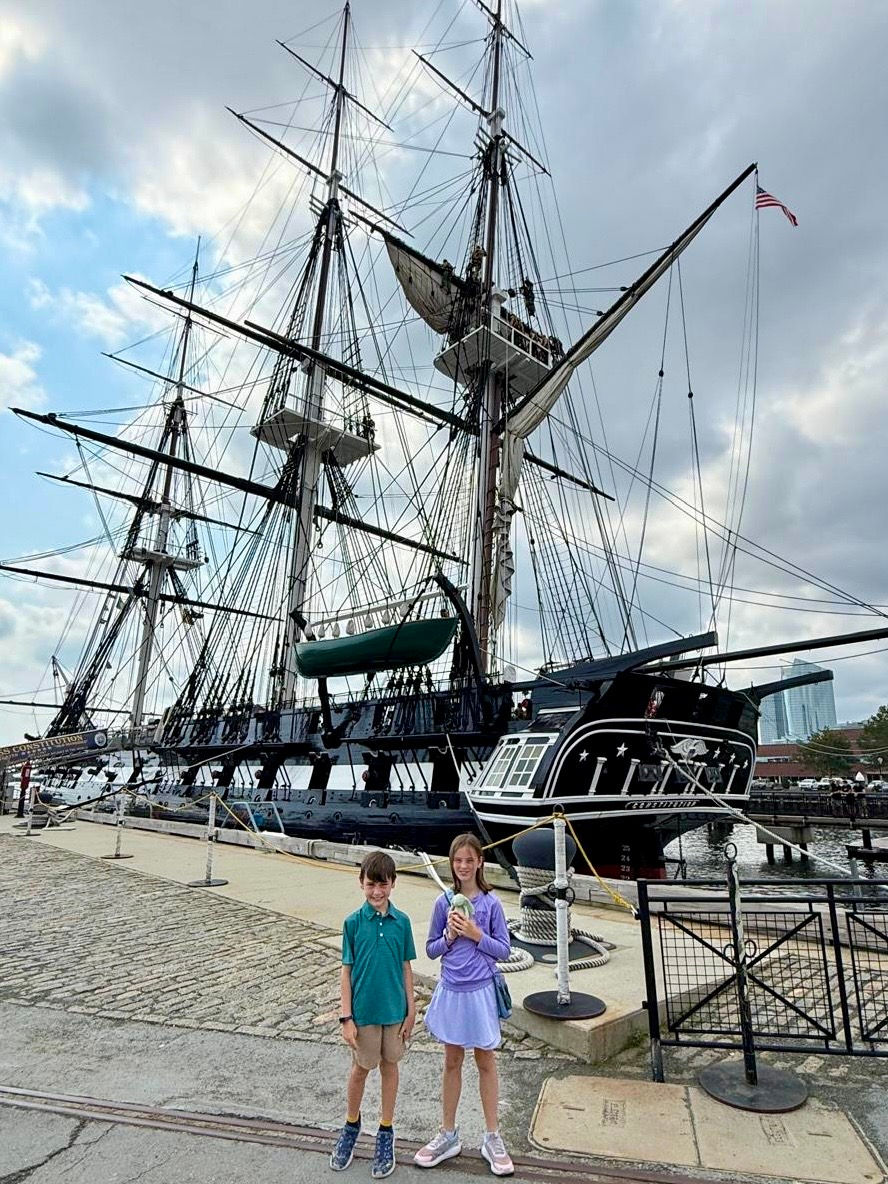
“Old Ironsides” belongs to the early republic rather than the Revolution’s opening, but it made the next chapter easier to understand. Declaring independence was one thing; the young country still had to defend itself and protect its trade.
Nearby, Bunker Hill showed that colonial forces could stand against British troops, despite ultimately losing the ground. That contradiction matters. History is full of short-term defeats that change what people believe is possible.
Battlefields can feel abstract to kids, but standing in the landscape helps. Where were the troops? What could they see? Why did the hill matter? What would it have sounded and felt like? Geography turns military history into human decisions.
The Boston Tea Party Museum: Protest You Can Participate In
The Boston Tea Party Ships & Museum was among the trip’s most interactive history stops (and the kids loved it!). The story unfolded through costumed interpretation, debate, ships, artifacts, and throwing tea into the harbor.

The lesson was not just that tea entered the water. We discussed taxation, representation, property destruction, political theater, and how protest movements decide which tactics are justified.
That opened a family discussion: When does protest become effective or harmful? Who gets to tell the story afterward? Those questions lack tidy answers, which is why they are worth asking.
Duck Tours, Geocaching, and the City Beyond the Textbook
Our Boston Duck Tour introduced the city by land and water: part history lesson, geography overview, and delightfully strange vehicle experience, a strong family-trip combination.
We also geocached at Cambridge Crossing Park, one of our favorite ways to make kids active city participants. With coordinates, clues, and reason to inspect the landscape closely, Eva and Jordan experienced Boston as both historic city and puzzle.

Food helped too. We ate at Quincy Market, had Italian food in the North End, and finished an evening with pastries from Mike’s Pastry. Regional food is not a break from cultural learning; it is an easy way into it.
Salem: Fear, Evidence, and the Stories Communities Tell
The kids arrived at the Salem Witch Museum expecting a story about witches and magic. Instead, they were surprised to find that the tour was really about social contagion: accusations spreading without evidence, fear shaping people’s behavior, and the damage that followed for the entire community.

That discovery made Salem more relevant than we expected. It also connected naturally with the Cry Witch courtroom experience we would later have in Colonial Williamsburg. Both experiences pushed Eva and Jordan to think about what counts as credible evidence and what can happen when a community stops asking for it.
Philadelphia with Kids: From Revolutionary Ideas to a New Government
If Boston showed us why a revolution began, Philadelphia showed us what came next.
Philadelphia picked up the story where Boston left off. At places such as the US Mint and National Constitution Center, we could see both sides of building a country: debating the rules of government and creating the everyday systems that make it work.
Staying with friends in Wayne gave us a family base and reminded us that connection is part of travel. Favorite moments included dinners at home, Eva and Jordan playing with friends, and the calm of returning somewhere familiar after a long day.
The US Mint: A Country Needs Systems, Not Just Ideals
Jordan collects bills and coins everywhere we travel, so the US Mint in Philadelphia was an easy choice for our family.
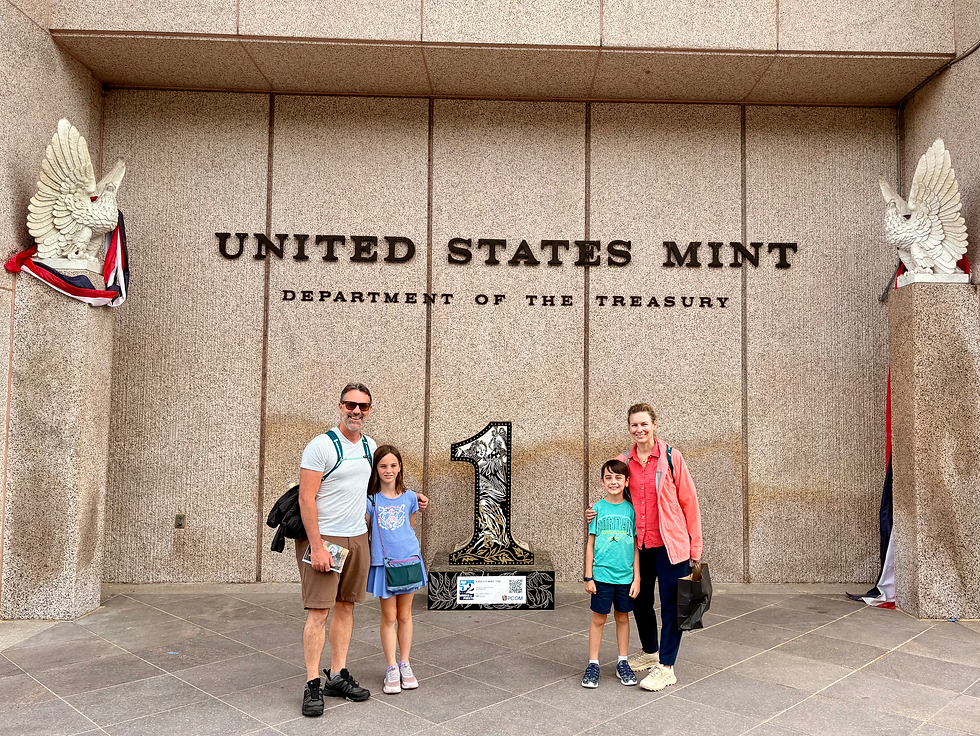
Before the visit, coin production felt like one of those mysterious processes that simply happened somewhere out of sight. Inside the Mint, we could watch the machines run and see the people doing the work. The scale and precision of the process brought it to life for all of us.
It also gave us plenty to wonder about: How are millions of coins produced accurately? Why do they carry particular symbols and words? What happens when one is defective? One favorite fact was that rejected coins are stamped in a special “waffling” machine before being recycled as scrap.
The visit made an everyday government system visible and made us look at the coins in our pockets differently.
The National Constitution Center: Designing a Government
The National Constitution Center connected founding debates to questions that still matter.
Terms such as branches, checks and balances, and federalism can make the Constitution sound remote. We wanted the kids to see the problem underneath the vocabulary: After winning independence, how could the country create a government strong enough to function without giving it so much power that liberty was threatened?
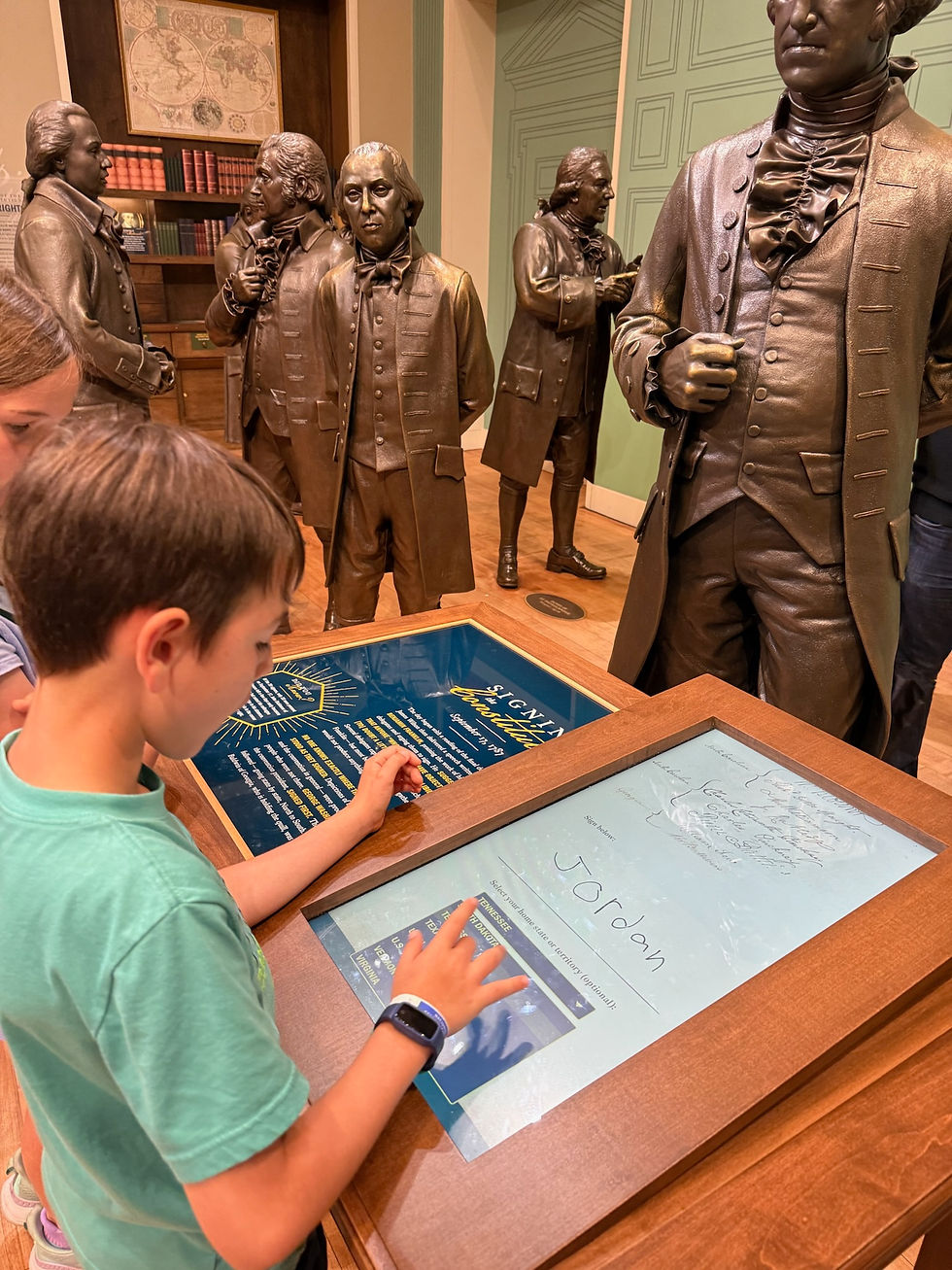
We discussed how “We the People” has been interpreted and expanded over time, and how amendments, including the Bill of Rights, helped the country more fully apply its founding ideals. The Constitution is both a durable framework and an invitation for each generation to preserve and expand liberties through self-government.
Liberty Bell and Independence Hall: Symbols and the Reality Behind Them
With long lines and no advance timed-entry tickets, we saw Independence Hall’s exterior and the Liberty Bell area rather than entering. Which, perhaps was a fail, but hey, we can’t win ‘em all. We walked around the outsides of both and still had engaging discussions about their histories.

We talked about how the Liberty Bell represents freedom, but symbols change as groups claim them. Abolitionists helped make the bell a national symbol of liberty, and later movements continued using its language and image.
The Declaration’s promise of equality, the Constitution’s framework, and the bell’s symbolism raised an important question: How can we continue to uphold the ideals of freedom for all Americans today?
Museum of the American Revolution: The War Through Human Eyes
The Museum of the American Revolution united political and military history through objects, stories, immersive galleries, and multiple perspectives. We were all big fans.
What worked especially well for us was the museum’s focus on people rather than abstract “sides.” Soldiers, families, Indigenous communities, enslaved people, loyalists, and revolutionaries all faced different choices and risks.
Instead of asking Eva and Jordan only what happened, we could ask why someone might join the Revolution, remain loyal, or simply try to survive a conflict they did not control. Those competing motives made the history harder, more honest, and more interesting.
Valley Forge: Endurance as Part of the Founding Story
At Valley Forge National Historical Park, Eva and Jordan completed the NPS Junior Ranger program. Valley Forge offered a quieter Revolutionary story: no decisive battle, but endurance in the face of brutal winter, training, organization, illness, supply problems, and the hard work of keeping an army together.

It countered the heroic version of history. Countries are built not only in dramatic moments, but through discipline, logistics, tremendous sacrifice, and persistence amid uncertainty.
Junior Ranger materials helped the kids slow down, observe, answer questions, and document their learning. We love how these programs turn a historic site from somewhere children are taken into somewhere they actively investigate.
Reading Terminal Market, Hersheypark, and Treetop Adventures
Philadelphia was not all founding documents and history. Staying with family friends, we made plenty of time to relax and have fun.
At Reading Terminal Market, Matt chose a cheesesteak while the kids chose spaghetti. So much for perfectly curated regional food education. That is family travel: You offer the local specialty, and sometimes your child wants noodles.

A full day at Hersheypark offered a joyful break from museums and historic sites. Another day, the kids completed multiple aerial courses and all 17 zip lines at TreeTrails Adventure Park.

Those days were not worldschooling detours. They brought physical education, confidence, persistence, and the fun that keeps a long trip balanced.
What Eva and Jordan Learned Across Both Cities
Together, the cities gave Eva and Jordan a clear sequence: resistance gathered momentum in Boston; independence led to the harder work of governing in Philadelphia. Three ideas connected the experience:
History is cause and effect. Protests, battles, declarations, and constitutional debates became linked choices rather than isolated dates.
Founding ideals require stewardship. The kids considered how the principles of liberty and equality guided the country, how the Constitution provided a framework for change, and how later generations worked to extend those ideals more fully.
Place shapes events. Harbors, roads, hills, and compact neighborhoods helped explain why history unfolded as it did.
Practical Tips for an East Coast History Trip with Kids
1. Teach the sequence before the details
Give children the two-part framework: Boston was resistance and revolution, and Philadelphia was independence and nation-building. They can attach details to that structure as the trip unfolds.
2. Alternate museums with movement
Pair the Freedom Trail with a Duck Tour. Follow constitutional exhibits with a market lunch, a park, or another active experience.
3. Use Junior Ranger programs
The National Park Service program at Valley Forge and Independence Hall gave Eva and Jordan an active role. Set aside enough time to complete the activities without rushing.
4. Build around a few anchor experiences
In Boston, choose the Freedom Trail and one interactive museum. In Philadelphia, choose either the National Constitution Center or Museum of the American Revolution, then add Independence National Historical Park. Let everything else be a bonus, particularly if you're short on time.
5. Reserve high-demand experiences early
Independence Hall timed entry, popular museums, tours, and special activities can fill. Book the non-negotiables first, then leave open space around them.
6. Expect tired feet and overloaded brains
These cities involve substantial walking, summer heat, crowds, and dense content. A quiet afternoon or home-cooked dinner can protect the next day.
Our Biggest Takeaway
Boston and Philadelphia gave Eva and Jordan a founding story they could walk through, from resistance and revolution to the difficult work of building a government.
Not every moment was profound. The kids chose spaghetti at Reading Terminal Market. We rode roller coasters, searched for geocaches, jumped through treetops, ate pastries, and watched movies with friends. That did not dilute the learning; it made the trip ours.
The Freedom Trail became more than a red line, the Constitution more than an old document, and Valley Forge more than a textbook name. The story is inspiring, complicated, and still unfolding, and now it is part of our family story too.
Author bio: Matt Nobles is a dad, husband, and relentless learner. After nearly 20 years in corporate finance and sustainability, and after having already travelled to 77 countries over the years, he's now spending the 2026–2027 academic year worldschooling with his wife Kelly and their two kids, Eva (11) and Jordan (9). Follow the journey at theglobalnobles.com.


