.png)
Colonial Williamsburg with Kids: History Comes Alive
Colonial Williamsburg with kids is history you can walk through, listen to, taste, and question. Instead of reading only about colonial government, trades, daily life, and the American Revolution, families can step inside the Governor’s Palace, visit the Capitol and Courthouse, watch craftspeople work, meet rare animal breeds, and follow the same streets where Virginia’s history unfolded.
We spent one full day exploring the Historic Area as part of our family’s East Coast journey. Our plan included the Governor’s Palace, Capitol, Courthouse, trade shops, military encampment, rare breeds, historic homes, and dinner at Christiana Campbell’s Tavern. It was an ambitious list, especially in the August heat, and we only experienced a portion of everything Colonial Williamsburg offers. Even so, it gave us exactly the kind of worldschooling day we love: structured enough to build understanding, flexible enough to follow curiosity, and memorable enough that the lessons did not feel like school. Families who want to explore the Historic Area and Art Museums more fully could easily spend three days or longer here, and after our visit, that is the approach we would recommend.
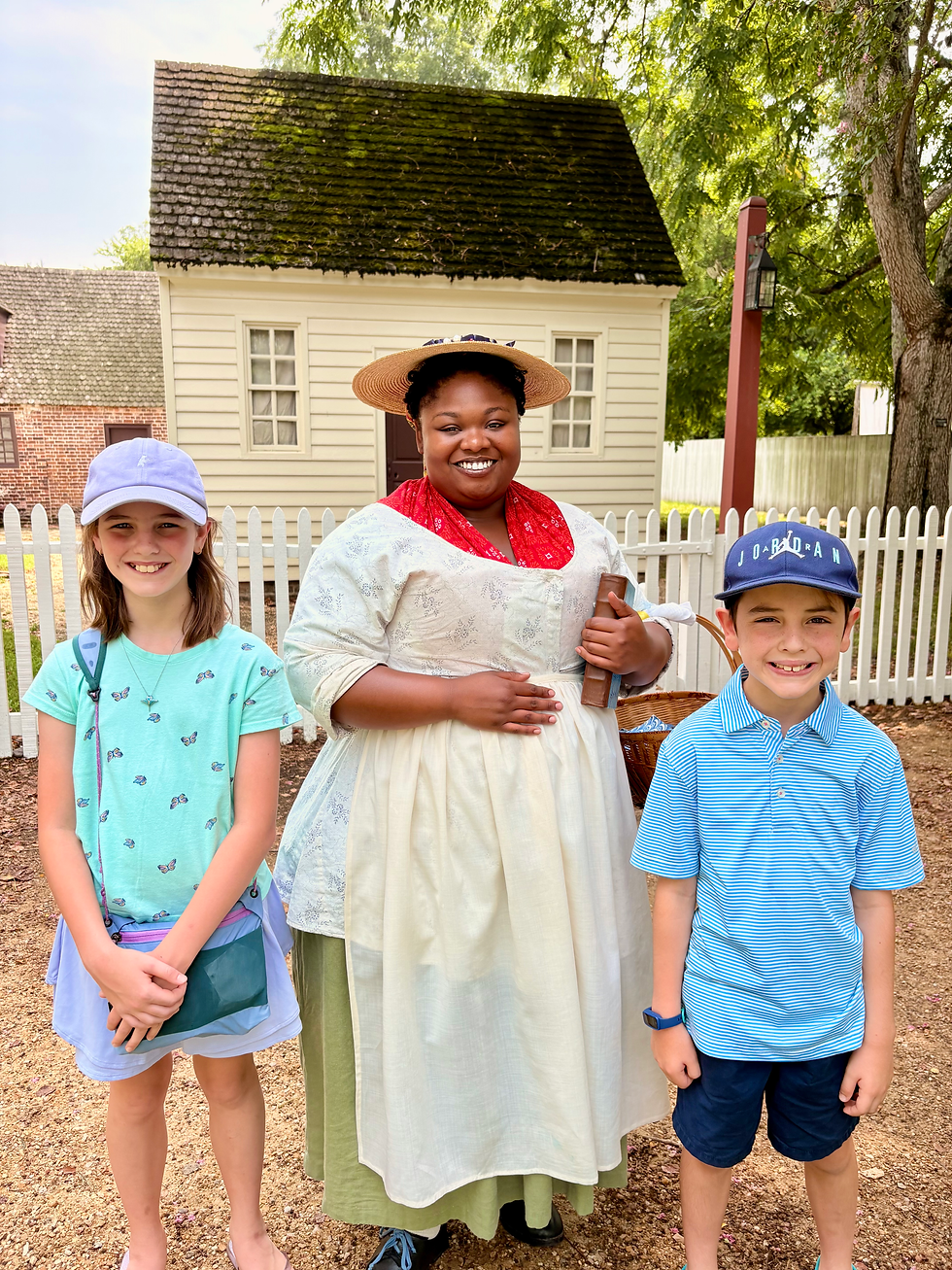
If you are considering Williamsburg with kids, our biggest advice is simple: do not try to turn it into a race between buildings. Pick a few anchor experiences, leave space for interpreters and demonstrations, and let your children’s questions shape the day.
Why Colonial Williamsburg Works So Well with Kids
Colonial Williamsburg is a 301-acre living-history museum, but that description does not fully capture the experience. The Historic Area feels less like a traditional museum and more like a town operating across two timelines at once.
You walk past gardens, taverns, workshops, homes, government buildings, animals, and interpreters dressed for the 18th century. A blacksmith may be shaping hot metal. A cook may be working over a fire. A political figure may be discussing independence. A military demonstration may suddenly gather a crowd. The next question is always waiting around the corner.
That variety matters for families. Kids who struggle with long museum labels may become completely absorbed when they can watch a craft unfold or ask an interpreter a direct question. History stops being a sequence of names and dates. It becomes choices, jobs, objects, homes, food, laws, and people.
For our family, Colonial Williamsburg also fit naturally beside our other worldschooling experiences. At Niagara Falls, the landscape became a science and engineering classroom. In Williamsburg, a town became a classroom covering the government, economics, technology, and culture of early American history.
Start with the Big Story, Not the Small Facts
Before visiting, it helps children understand one simple idea: Williamsburg was Virginia’s colonial capital from 1699 to 1780. It became an important place for debates about law, taxation, representation, independence, and government.
That context gives the major sites a purpose:
The Governor’s Palace represented royal authority and executive power.
The Capitol was where lawmakers debated and made decisions.
The Courthouse showed how law affected everyday life.
Taverns and coffeehouses were places for news, business, meals, and political discussion.
Trade shops reveal how almost everything required time, skill, tools, and human labor.
Homes, kitchens, gardens, and archaeological evidence help tell the stories of people who did not hold formal political power.
We did not need Eva and Jordan to memorize every date. We wanted them to see the connections. Who made the rules? Who could participate? Who did the work? Who benefited from the system? Who was excluded? What did words such as liberty mean in a society built partly on enslavement?
Those questions are more valuable than a perfect list of facts, and Colonial Williamsburg gives families many opportunities to ask them.
Our Colonial Williamsburg Day
We based ourselves at the Williamsburg Woodlands Hotel & Suites, close to the Visitor Center and convenient for the Historic Area. That location made it easier to begin with orientation, use the shuttle, and return to the hotel when we needed a reset.
Because we had only one day, we centered our visit on the Historic Area, choosing a mix of government buildings, historic homes, trades, animals, and military history. We covered a surprising amount, but we could not see every building, demonstration, program, or museum.
Governor’s Palace: Power, Performance, and a Maze
We started our day with a tour of the Governor’s Palace, which is one of the clearest places for children to see how architecture communicates power. The building, formal rooms, grounds, and Palace Green all project authority.
For kids, the experience is not limited to furniture and portraits. The working kitchen makes daily life more tangible, while the garden maze adds movement and play to a site that might otherwise feel formal. That combination works well. Families can talk about political power inside, household labor behind the scenes, and then let everyone burn some energy outdoors. Jordan loved pulling Matt through the maze, over and over, exploring every turn and dead-end until the entire thing was memorized.

The Palace also creates an opening for one of the most important questions of the day: how many people were required to support the comfort and status of the governor’s household, and whose stories are easiest or hardest to see?

The Capitol and Courthouse: How Rules Become Real
At the Capitol, government becomes a place rather than an abstract idea. Children can imagine lawmakers debating taxation, rights, representation, and independence in actual rooms built for those arguments.
The Courthouse brings the consequences of law closer to everyday life. Laws affected property, work, debt, punishment, freedom, and family life. For older children, this is a good place to compare colonial ideas of justice with modern expectations. For younger children, a simpler question works: who made the rules, and did everyone get a say?
Visiting the Palace, Capitol, and Courthouse in the same day creates a useful triangle: executive power, lawmaking, and enforcement. It gives kids a framework they can carry into future lessons about government.
Trade Shops: The Best Hands-On History
The working trades were some of the most valuable stops in our plan. We looked for blacksmithing, tin work, millinery, tailoring, wigmaking, and other crafts along the Historic Area.
Trade demonstrations make history wonderfully concrete. A child can see the tools, hear the sounds, notice the materials, and understand how long skilled work takes. A handmade object is no longer just something sitting behind glass. It becomes the result of training, patience, heat, strength, precision, and repeated practice.

These stops can also spark conversations about economics:
Where did raw materials come from?
How did apprentices learn?
Who could enter a trade?
How were goods priced and sold?
What work happened in homes rather than shops?
How did enslaved labor support the colonial economy?
This is what worldschooling looks like at its best. A child notices a tool, asks a question, watches an expert demonstrate a skill, and leaves understanding more than a worksheet could have conveyed.
Military Encampment and Noonday Cannon
The military encampment and noonday cannon added sound, movement, equipment, and urgency to the day. Military history can easily become a list of battles, but an encampment helps children think about the daily reality behind conflict.
What did soldiers carry? Where did they sleep? How did they communicate? What did discipline look like? How loud is a cannon when you are standing nearby rather than watching through a screen?
The sensory part of living history can make a lesson stick, but prepare children who are sensitive to sudden noise. Check the daily schedule and ask staff where to stand if anyone in the family would prefer a little distance.
Rare Breeds, Gardens, and Everyday Life
The rare breeds program offers a gentler counterpoint to formal buildings and political stories. Historic livestock breeds, gardens, kitchens, and foodways help explain how people fed a community before supermarkets, refrigerators, and modern supply chains.
Animals are often an easy entry point for kids. From there, the conversation can expand into agriculture, breeding, land use, food preservation, household work, and the seasonal rhythm of life.
It also reminds families that history is not only what happened in government buildings. Much of life happened in fields, kitchens, workshops, yards, and homes.

Historic Homes: Many Lives Behind the Famous Story
We also planned time for historic homes including the Peyton Randolph House, James Geddy House, and George Wythe House. Homes help shift the focus from public events to private lives.
Each house can reveal different layers of class, occupation, family structure, labor, material culture, and enslavement. The objects in a room become evidence. Who slept here? Who cooked? Who cleaned? Who owned the furniture? Who made it? Which people appear in written records, and which must be understood through archaeology and careful interpretation?
Dinner in the Historic Area
We ended our main day with dinner at Christiana Campbell’s Tavern. A historic tavern meal is more than a convenient dinner. It extends the setting into the evening and gives children another way to imagine how food, hospitality, news, and social life came together. During our meal, a musician in historic garb played the fiddle and flute (in turns) while performing traditional American songs, which was an unexpectedly fun highlight for the kids and adults alike.

Popular taverns can book early, especially during summer and major commemorative periods, so reserve ahead. Even if you do not choose a historic tavern, Merchants Square and the surrounding area offer family-friendly alternatives.
After a full day of walking and concentrating, dinner is also a chance to reflect without making it formal. Ask everyone to name one surprising fact, one favorite place, and one question they still have. The answers may tell you more than a quiz.
Cry Witch: When the Kids Helped Decide the Verdict
One of our most memorable evening experiences was Cry Witch, an interactive courtroom program built around the trial of Grace Sherwood, the Virginia woman historically accused of witchcraft. Rather than simply watching the story unfold, the audience became part of the proceeding, listening to the testimony and weighing the evidence before voting on the verdict.
Eva and Jordan took their responsibility seriously. They both voted not guilty, and this time their side won the verdict. The experience gave them an immediate way to think about evidence, fairness, fear, and what happens when suspicion carries more weight than proof.

For worldschooling families, the program creates a natural bridge between history and civics. What counts as reliable evidence? How can a community’s beliefs influence a trial? Would the same testimony be treated differently in a modern courtroom? Because the kids had a real vote, those questions felt personal rather than theoretical.
The subject matter and dramatic setting may feel intense for sensitive children, so check the current age guidance before booking. For our family, however, the suspense and audience participation made Cry Witch one of the experiences we continued discussing after the verdict was announced.
A (Not-too-scary) Ghost Tour
We also explored the town after dark on the Haunted Williamsburg tour. The streets felt completely different once the daytime crowds faded and the historic buildings were lit against the night. Stories of unexplained events, local legends, and people connected to the town’s past added mystery to places we had already visited in daylight.

The tour was entertaining, not too scary for Eva or Jordan, and also offered another way to consider how history is remembered. Ghost stories often grow around real people, difficult events, and buildings that have accumulated generations of memories. We encouraged the kids to enjoy the suspense while also asking which details came from documented history, which belonged to oral tradition, and which might have been added for dramatic effect.
For families, the tour is a fun way to extend a Colonial Williamsburg day without visiting another formal exhibit. Bring comfortable shoes, prepare younger or more sensitive children for spooky stories, and remember that the darkness and atmosphere can make even a mild tale feel more intense. For Eva and Jordan, the combination of history, mystery, and nighttime adventure made the experience especially memorable.
What Kids Can Learn at Colonial Williamsburg
A day at Colonial Williamsburg can connect subjects that are usually separated at school.
Government and Civics
The Palace, Capitol, Courthouse, coffeehouse, and taverns show how political power moved through institutions and social spaces.
Economics and Skilled Work
Trade shops demonstrate specialization, apprenticeship, supply chains, pricing, and the value of skilled labor.
Technology and Engineering
Tools, construction methods, metalwork, clothing production, kitchens, weapons, and transportation show how people solved practical problems with the available technology.
Agriculture and Food Systems
Rare breeds, gardens, kitchens, and taverns connect land, labor, seasons, preservation, cooking, and consumption.
Social History
Homes and interpreters help families consider how race, class, gender, age, legal status, and occupation shaped daily life.
Historical Evidence
Buildings, documents, tools, ceramics, clothing, landscapes, and archaeological finds all show how historians reconstruct the past.
Critical Thinking
Children can compare ideals with reality. The Revolution raised powerful ideas about liberty and representation, but those rights were not shared equally. That tension is not a side note. It is essential to understanding the period.
Recommendations for Visiting Colonial Williamsburg with Kids
1. Plan three or more days if you can
We spent only one full day, and it gave us an excellent introduction to Colonial Williamsburg, but not enough time to explore everything without making difficult choices. Many families spend three days or longer fully experiencing the Historic Area, trade shops, scheduled programs, evening events, and Art Museums. Based on our visit, we would recommend that slower approach if your itinerary allows. If you have just one day, choose a few anchor experiences and treat everything else as a bonus. Plan additional days beyond Colonial Williamsburg if you also want to visit Jamestown or Yorktown.
2. Choose three anchor experiences
Pick one government site, a couple trades, and one child-led interest as your must-dos. For us, the Governor’s Palace, the government buildings, and working trades created a strong foundation. Everything else was a bonus.
3. Start at the Visitor Center
The Colonial Williamsburg Regional Visitor Center offers free parking, restrooms, ticket help, orientation, and shuttles. Starting there helps the day feel manageable.
4. Check the daily schedule before you arrive
Programs, building access, military demonstrations, interpreters, and trade presentations vary by date. Review the official event calendar and build your route around time-specific activities.
5. Expect a lot of walking
The Historic Area includes brick, gravel, grass, and uneven surfaces. Wear comfortable shoes and use the shuttle to save energy. A lightweight stroller may help younger children, but historic terrain can be bumpy.
6. Take August heat seriously
Summer days can be hot, humid, and stormy. Start early, carry refillable water bottles, use sunscreen and hats, and plan an indoor break during the hottest part of the afternoon. Portable fans and light rain gear are worth packing.
7. Alternate listening with movement
Follow a building tour with a garden, maze, animal stop, or short shuttle ride. Kids absorb more when they have regular chances to move.
8. Let children ask the interpreters questions
Interpreters are one of the site’s greatest resources. Encourage each child to prepare one question, but leave room for spontaneous curiosity. Questions about clothing, tools, food, childhood, and animals are easy conversation starters.
9. Use a simple scavenger hunt
The Junior Historians Exploration Quest gives children a purpose while exploring.
10. Book popular extras early
Historic tavern meals, carriage rides, evening programs, and special events can fill quickly. This is especially important during holidays, summer, and America’s 250th-anniversary programming in 2026.
Our Biggest Colonial Williamsburg Takeaway
Colonial Williamsburg reminded us that history becomes more meaningful when children can see both the grand ideas and the ordinary work behind them.
The grand ideas were everywhere: liberty, representation, law, revolution, government. But so were the practical realities: making shoes, preparing food, tending animals, shaping metal, sewing clothes, maintaining homes, enforcing rules, and doing the labor that allowed a colonial capital to function.
Those two layers belong together. The Revolution was argued in important rooms, but the society around those rooms was built and sustained by thousands of people whose experiences differed dramatically.
To be fair, a family visit will not answer every question. Schedules change. Kids get hot. Adults get tired. A carefully planned route may fall apart because one child wants to watch the blacksmith for another 20 minutes.
That is not a failure. It may be the whole point.
Worldschooling is not about completing every stop. It is about noticing when curiosity takes hold and giving it room. At Colonial Williamsburg, the past does not sit quietly behind glass. It speaks, works, cooks, debates, marches, and asks families to look more closely. For us, that made Williamsburg more than a historic attraction. It became a memorable and fun day of government, craftsmanship, agriculture, ethics, evidence, movement, and family discussion.
History came alive, and once it did, the conversation continues, even after we left.
Author bio: Matt Nobles is a dad, husband, and relentless learner. After nearly 20 years in corporate finance and sustainability, and after having already travelled to 77 countries over the years, he's now spending the 2026–2027 academic year worldschooling with his wife Kelly and their two kids, Eva (11) and Jordan (9). Follow the journey at theglobalnobles.com.


