.png)
Kenya & Tanzania Safari with Kids: 11 Days of Wonder
Updated: Jul 9
A Kenya and Tanzania safari with kids is one of those family trips that sounds almost too good to be real … baby elephants bottle-fed in the mud, giraffes eating out of your hand, lions asleep in the Serengeti grass, and kids whispering from the back seat because even they know some moments deserve silence. The whole thing was even better than we had hoped. For us, East Africa was eleven days of wonder, a soggy first night in Nairobi, an elephant orphanage that moved all four of us, hand-feeding giraffes, luxury lodges we never expected, cold pools the kids jumped into anyway, and a guide named Alladin who turned the Serengeti into the best classroom we could imagine.
We flew into Nairobi from Dubai, spent a few unforgettable days in Kenya, then crossed into northern Tanzania for a classic safari circuit. By the time we rode back to Kilimanjaro International Airport, East Africa had rearranged our family’s memory bank. It wasn’t just “we saw animals.” It was we learned to notice … tracks in the dust, birds in the trees, the difference between a rock and a sleeping lion seen from a distance, and the very specific joy of an 8-year-old spotting a dwarf mongoose and declaring it his “second favorite” animal in the world (after hedgehogs, of course).
Why Kenya and Tanzania Worked So Well for Our Family
East Africa gave our family the perfect mix of structure and surprise.
The structure came from the plan: flights, transfers, planned lodges, daily game drives, and a route that moved us from Nairobi to Arusha, Lake Manyara, the Serengeti National Park, the Ngorongoro Conservation Area, and Tarangire National Park.
The surprise came from everything else. Pouring rain on our first night in Nairobi. Baby elephants in the mud. A giraffe’s blue tongue reaching for food in Eva’s hand. A sky that changed color every hour over the Serengeti. Bow-and-arrow practice at camp. A wrong hotel that turned into an accidental night game drive. Cold pools that were apparently irresistible. And a safari guide with 16 years of experience who could explain animal behavior, landscape, local culture, and travel logistics while keeping Eva and Jordan engaged through long drive days.
For a worldschooling family, this trip wasn't a “field trip.” It was the field, the textbook, the lab, the geography lesson, the biology lesson, and the family story all at once.
Our East Africa Safari Route Summary
Our trip ran over 11 days at the end of May. We started in Nairobi, Kenya, then flew to Kilimanjaro International Airport and worked our way through northern Tanzania's classic safari circuit:
Date | Base / Lodge | Main Experience |
May 21 | Arrive Nairobi (DXB → NBO), rainy first night | |
May 22 | Sheldrick elephant orphanage, Carnivore lunch, Giraffe Centre | |
May 23 | Karura Forest hike, Nairobi National Museum, fly NBO → JRO, transfer to Arusha | |
May 24 | Lake Manyara game drive and treetop walkway | |
May 25 | Transfer into the Serengeti and afternoon game drive | |
May 26 | Full Serengeti safari day | |
May 27 | Morning Serengeti game drive, Lemala Cubs Program, transfer to Ngorongoro | |
May 28 | Ngorongoro Crater game drive, transfer to Tarangire | |
May 29 | Tarangire game drive | |
May 30 | Final Tarangire game drive and transfer toward the airport | |
May 31 | JRO departure | Transfer to Kilimanjaro International Airport, fly home |
If you’re planning a Kenya and Tanzania safari with kids, this route is a strong template. Kenya front-loads the trip with city culture, conservation, and unforgettable animal encounters. Tanzania then delivers the big wild landscapes: forests and lake views in Manyara, endless plains in the Serengeti, the drama of Ngorongoro Crater, and elephant-rich Tarangire at the end.
A Tour Company We Already Trusted: Peak Planet
One reason this trip felt so smooth from the start was that we booked it through Peak Planet, the very same company Kelly and I used back in 2012 when we summited Kilimanjaro together. They were and are great … every bit as organized, responsive, and genuinely caring as we remembered, handling the logistics across two countries so we could focus on the experience instead of the spreadsheet. If you’re considering a Kenya and Tanzania safari with kids, we can't recommend them highly enough, a fantastic tour company that earned our trust on a mountain and kept it on the plains.
The Kenya Days: Nairobi with Kids
People sometimes treat Nairobi as a quick stopover before the “real” safari. To be fair, we understand the temptation, the wild plains are why most families come. But honestly? Skipping Nairobi would have been a mistake. Our Kenya days were some of the most meaningful of the entire trip, and Nairobi turned out to be one of the best family-travel cities we've experienced. If you’re planning Nairobi with kids, give it real time.
Day 1: A Very Wet Welcome
We flew Dubai to Nairobi (DXB → NBO, EK719, departing 10:30 AM, arriving 2:30 PM) and checked into Wildebeest Eco Camp, a leafy, tented haven tucked into the city.
That first night, it absolutely poured. Crazy, drumming, won’t-stop rain on the canvas. And honestly? It was perfect. There’s something about arriving in a brand-new country, listening to rain hammer your tent, and realizing the adventure has officially begun (especially when you’re coming from a home in the desert where it rarely rains). The kids thought it was thrilling. We thought it was a good reminder: you can't control the weather, only how you respond to it. That became a small theme for the whole trip.
Day 2: Baby Elephants, Giraffes, and a Beast of a Feast
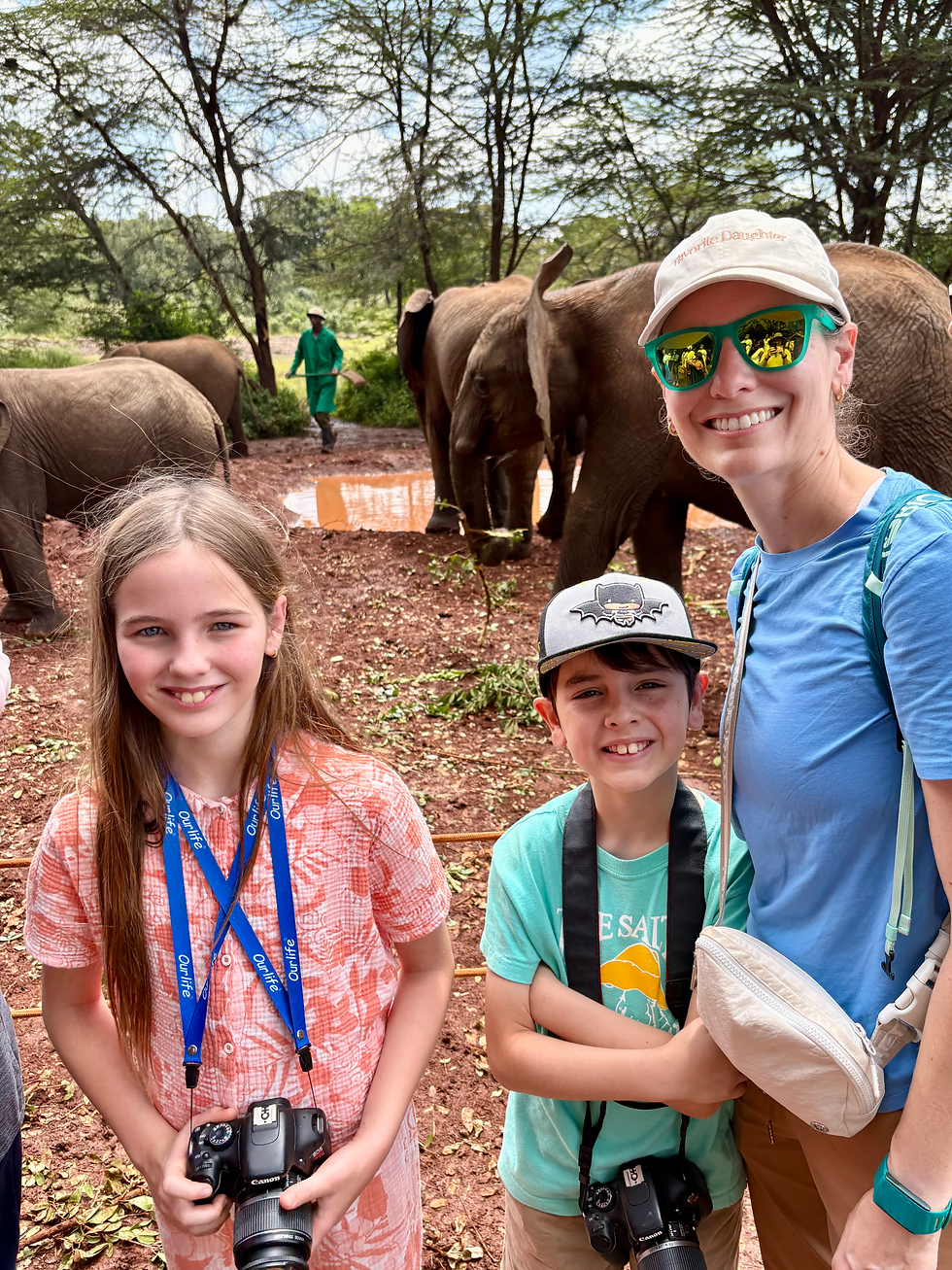
Our first full Kenya day might be one of the best single days of the whole trip.
We started at the David Sheldrick Wildlife Trust Orphans Project, where orphaned elephants and rhinos are rescued, raised, and eventually returned to the wild. Watching the babies get bottle-fed, play in the mud, and stay close to their keepers was genuinely emotional for all four of us. Nobody warned us we’d tear up over an elephant before lunch.
It was also the morning we became adoptive animal parents. Through the Trust’s fostering program, each of us “adopted” an animal:
KaiKai (elephant) - Kelly’s, doubling as a 14-year anniversary gift (I chose an adopted elephant instead of the traditional ivory gift, a good switch, I think)
Daba (elephant) - Matt’s
Toto (elephant) - Eva’s
Tytan (rhinoceros) - Jordan’s
Here’s what nobody tells you: adopting an animal turns “looking at wildlife” into something personal. The kids weren’t just visitors anymore. They had a stake in a specific creature, a name to remember, and a reason to care about conservation that will outlast the trip. And the Sheldrick Trust keeps that connection alive by sending monthly email updates to us about each adopted animal, plus ongoing Keeper’s Diary entries you can read on their website.
For lunch, we went full carnivore at Carnivore Restaurant Nairobi, the famous “Beast of a Feast.” It's exactly as dramatic as it sounds, meat carved tableside until you surrender, and the kids treated the whole thing like a delicious dare.

We also stopped at Kobe Tough for a beads production tour and shop, where the kids watched handmade jewelry and leather goods being created. Watching things actually get made, by hand, with real skill, is one of those quiet worldschooling wins that sticks with kids more than any souvenir.
Then came a family favorite: the Giraffe Centre, run by the African Fund for Endangered Wildlife. Feeding giraffes by hand, eye-to-eye on a raised platform, is the kind of thing that makes kids squeal and adults grin like kids. Those long blue tongues, those impossibly long lashes, that gentle reach … pure joy. We went back to Wildebeest Eco Camp that night completely full, in every sense.
Day 3: Forest Hikes, Museums, and the Flight South
On our final Kenya morning we headed to Karura Forest, an urban forest oasis maintained by the Friends of Karura Forest. We did a roughly 4-mile family hike to a waterfall and caves, a chance to stretch our legs, burn off some kid energy, and see a very different side of Nairobi: green, fresh air, quiet, and full of birdsong right inside the city.
We had lunch at CJ's in the Village Market (our kids said it was the “African Cheesecake Factory”), then visited the Nairobi National Museum for a dose of Kenyan history, culture, and natural history. After days of live wildlife, the museum helped the kids put it all in context, connecting animals, people, land, and story.
Then it was time to fly south. We caught the NBO → JRO flight (KQ428, originally scheduled to depart at 4:40 PM, but pushed twice to 9:30 PM, ouch) and crossed into Tanzania, where our tour guide Alladin (more about him later) met us for the transfer to Arusha. Kenya had set the bar high. Tanzania was about to clear it.
Worldschooling note: Nairobi alone delivered conservation (Sheldrick), biology and gentle animal encounters (Giraffe Centre), craftsmanship and economics (Kobe Tough beadwork), ecology and exercise (Karura Forest), and history and culture (Nairobi National Museum). No worksheets required … though Eva would later add 40 of those in Tanzania, by choice.
The Tanzania Days: Into the Safari Circuit
If Kenya was about culture, conservation, and up-close encounters, Tanzania was about scale. This is where the trip went from “awesome” to “we'll be telling these stories for the rest of our lives.”
Day 1 in Tanzania: JRO to Arusha — Late Night Drive to the Bush
We landed at Kilimanjaro International Airport just before 11:00 PM and started the one-hour transfer to Arusha for a night at Hamerkop House by Lemala. It was late, it was dark, and the last stretch was bumpy enough to feel like a preview of safari roads, and yet the kids still quickly fell asleep in the car (even on the dirt road).
Hamerkop House was exactly the soft landing we needed … way nicer than expected, with exceptionally accommodating staff. We arrived, went straight to bed, and let the night do its work. In the morning, everything felt reset: a warm welcome, a quick tour to get oriented, and a great breakfast that made us feel human again.
Here’s a solid recommendation: don’t rush straight from an arrival into a safari day if you can avoid it. Give your family a buffer night near Arusha. You’ll enjoy the rest of the trip more.
Day 2 in Tanzania: Lake Manyara — Forest, Water, and a Walk in the Trees
Our first proper safari day took us to Lake Manyara, a wonderful introduction because the landscape felt so different from the classic “endless plains” image most of us carry in our heads.
Lake Manyara is green, layered, and full of texture. There’s forest. There’s water. There are birds everywhere. The road tucks into the trees before opening into wider views. For kids, that variety helps. Instead of staring across a huge horizon all day, Manyara gives them things to notice close-up.
We also did the Lake Manyara treetop walkway, a perfect family activity. After time in the vehicle, walking above the forest canopy gave the kids a different kind of adventure. Safari can be surprisingly sedentary … lots of sitting, looking, waiting, and whispering, so any chance to move our bodies helped reset everyone.
The Animals of Lake Manyara
Manyara was the perfect warm-up for our eyes. Almost as soon as we entered the park, troops of olive baboons and blue Sykes' monkeys crossed the road in front of us while vervet monkeys watched from the branches. Giraffes browsed among the trees, zebras grazed in the open clearings, and we spotted our very first elephants of the trip moving through the forest. The birds were just as exciting … a sudden splash of red from a red bishop and the metallic blue-and-orange shine of a superb starling had everyone grabbing for the binoculars.
That night we stayed at Escarpment Luxury Lodge. “Luxury” is right there in the name, and the lodges on this trip kept surprising us. We expected the safari to be amazing. We didn’t expect the rooms, staff, food, and settings to be this comfortable. Tanzania gave us wild days and very civilized evenings, a pretty magical combination when traveling with kids.
Days 3–4 in Tanzania: Into the Serengeti — The Big Safari Feeling
The transfer to the Serengeti National Park is when the trip started to feel enormous.
The Serengeti has a way of making adults quiet. It’s not just beautiful … it feels ancient, open, and alive in every direction. The horizon stretches forever, and then the “empty” landscape turns out not to be empty at all. There are antelope you didn't notice at first. Birds on the ground. Movement in the grass. A shape under a tree that becomes a lion once your eyes adjust.
This is where our guide, Alladin, became central to the experience. With 16 years of guiding behind him, he did far more than drive. He helped us understand what we were seeing, kept the kids engaged, and knew exactly when to wait, when to move, when to explain, and when to let a moment just be the moment. We were lucky to have him.
We stayed at Lemala Ewanjan Tented Camp, which delivered the full tented-camp experience without sacrificing comfort. For the kids, sleeping in a tented camp in the Serengeti felt wonderfully adventurous. For the adults, it felt like a small miracle that “adventurous” could still include a proper bed and good food.
A Serengeti Full of Wildlife
The Serengeti delivered wildlife on a scale that's almost impossible to describe. The big cats alone made our jaws drop. In a single day we counted five leopards, some draped lazily along the branches of sausage trees, others walking right through the bush out in the open. Lions were everywhere throughout the park, and one afternoon we watched a lioness on a hunt creep toward a herd of impala, only to spook them a beat too early and give up, flopping down in the grass as if she'd meant to rest all along. We also spotted cheetahs scanning the plains, while spotted hyenas and jackals patrolled the edges.
Beyond the predators, the plains were alive in every direction. Vast herds of wildebeest moved across the grass alongside Thomson's and Grant's gazelles, topi, hartebeest, eland, impala, and the tiny dik-dik. Warthogs trotted past with their tails straight up, hippos crowded the water, and a Nile crocodile lurked at the river's edge. The birding was just as rich, ostriches, a stately secretary bird, kori bustards, a spotted eagle-owl, saddle-billed storks, tawny eagles, African fish eagles, grey herons, and Egyptian geese, while a banded mongoose and a rock agama lizard added their own flashes of color. Even the trees became part of the lesson, from the flat-topped umbrella thorn and whistling thorn acacias to the unmistakable sausage tree.
The Wrong Camp That Became a Bonus Night Drive
One of the funniest memories of the trip came from a mistake.
After a long day driving from Lake Manyara into the Serengeti, plus an afternoon game drive, we arrived at what we thought was our camp. Except, it wasn’t. Our park permit had listed the wrong hotel (no fault of our guide!), so we’d driven to the wrong place.
This is the kind of moment that can break a travel day. The kids are done, and everyone is tired (including the adults!). The parents are trying to stay cheerful while quietly calculating remaining daylight and energy levels. And then you learn you need to get back in the vehicle and drive another hour.
But Tanzania had a surprise for us: that extra hour became an accidental night game drive across the Serengeti. We saw animals that were active at night that we might otherwise have missed during the day … hyena, jackal, owls, and hare. The whole mistake transformed from frustration into one of those stories we’ll tell for years. That’s travel with kids in a nutshell. Sometimes the thing that goes wrong becomes the thing everyone remembers.
Day 5 in Tanzania: Serengeti to Ngorongoro — Cubs, Bush Walks, and Helping Strangers
Before our final Serengeti game drive, Eva and Jordan enjoyed one of the most kid-friendly experiences of the trip: the Lemala Cubs Program.
Eva and Jordan practiced bow-and-arrow shooting, went on a short bush walk, and learned to identify different kinds of animal poop. If you’re a parent, you already know: animal poop is educational gold. It’s science, tracking, ecology, humor, and gross-out factor all in one. The kids were fully in.
This is one of the reasons Tanzania worked so well for worldschooling. The learning wasn’t abstract. Nobody had to say, “Please pay attention, this is biology.” The kids were already paying attention because the lesson was in front of them, on the ground, connected to the animals they’d just seen.
Later in the day, on the way toward Ngorongoro, we had one of those small human moments that stays with you. We saw another truck having car trouble and stopped to help. It turned out the couple was headed to our same hotel, so we gave them a ride. They were also traveling from Dubai, recently married on their honeymoon safari. After days of animal sightings, it was a reminder that travel is also about the people you meet between the postcard moments. That night we stayed at Lion's Paw Ngorongoro, another amazing tented hotel, positioned for the next morning’s crater experience.
Day 6 in Tanzania: Ngorongoro Crater — The Safari Bowl
The Ngorongoro Conservation Area is one of the most dramatic landscapes we’ve ever visited as a family. The crater feels like a natural amphitheater … a vast bowl of grassland, water, wildlife, and sky.
For kids, Ngorongoro is easier to understand visually than some safari landscapes. You can see the shape of it. You descend into it. You feel contained inside something massive. It’s geography you experience with your whole body.
Our morning crater game drive gave us a different kind of safari day: less endless horizon, more concentrated drama. Instead of scanning far-off plains, we were reading the crater floor, watching clusters of vehicles, eyeing the water, and trying to understand how so many animals fit into one ecosystem.
Wildlife on the Crater Floor
The crater floor gave us sightings we'd been hoping for all trip. The highlight was the black rhinoceros, rare, endangered, and a real thrill to finally find in the distance. Big herds of African buffalo grazed across the grassland, and out on the soda lake a shimmer of pink turned out to be lesser flamingos wading through the shallows.
After the crater, we transferred toward Tarangire and checked into Lemala Mpingo Ridge. Another lodge that exceeded expectations. By this point we had a rhythm: early mornings, game drives, dust, animal sightings, lodge arrival, food, showers, and (somehow, despite the cold) swimming. The pools were freezing, but the kids insisted.
Days 7–8 in Tanzania: Tarangire — Elephants, Mongoose, and 40 Worksheets
Tarangire National Park was our final major safari area, and it gave us some of the most joyful family memories of the whole trip.
Tarangire is famous for elephants, and seeing elephants as a family never gets old. They’re huge and gentle-looking and powerful and funny, moving with such calm confidence. After adopting baby elephants at the Sheldrick Trust in Kenya, the kids already felt emotionally connected to elephants, and Tarangire gave that connection a wild, full-grown setting.
It was also in Tarangire that Jordan found a new favorite animal: the dwarf mongoose. Not the lion or leapord. Not the elephant. Not the giraffe, hippo, or rhino. The dwarf mongoose.
Honestly, this is one of our favorite things about traveling with kids. Adults arrive with a mental list of “iconic” things we're supposed to care about. Kids notice differently. They fall in love with the small, quick, weird, funny, unexpected creature. And once Jordan crowned the dwarf mongoose, we all started paying closer attention.
Tarangire's Elephants and the Poachers Hideout
Tarangire's elephants were the showstopper. Big herds passed right alongside our truck, close enough to hear them breathe, with tiny babies tucked safely among the adults, one of the most magical moments of the entire safari. We also stopped at the famous "Poachers Hideout," an enormous hollowed-out baobab, and climbed inside to take a family picture. Between the giant baobabs and the strange candelabra trees, the landscape felt almost prehistoric, and we kept adding new sightings along the way: a shy genet, rock hyrax, silver-backed jackals, and a colorful parade of birds including the lilac-breasted roller, red-billed hornbill, white-bellied go-away bird, and a darting kingfisher.

Eva's 40-Worksheet Elephant Necklace Challenge
Tarangire also gave us one of Eva’s great trip stories.
On Day 7, Eva spent the entire day (while in a bumping 4x4 on a gamedrive) completing 40 detailed worksheets about Africa to earn a $40 gold and stone elephant necklace from the hotel shop (admittedly a very expensive necklace).
That sentence tells you almost everything about Eva: relentlessly determined, creative, motivated, and fully capable of turning a safari truck into a personal academic challenge. It also tells you something about worldschooling. Learning on the road doesn’t always look like a perfect curriculum plan. Sometimes it looks like a child deciding a necklace is worth 40 (tough, Africa-focused) worksheets, then sitting down and doing the work.
Was it traditional school? Not exactly. Was it motivation, geography, reading, persistence, math, social studies, and goal-setting wrapped into one memorable day? Absolutely.
We spent two nights at Lemala Mpingo Ridge, which gave us time to enjoy Tarangire without rushing. On May 30, we had a final morning game drive before transferring toward Airport Planet Lodge for our last night near Kilimanjaro Airport.
Day 9 in Tanzania: Back to JRO — The Quiet Ride Out
Our final transfer to JRO was provided by Planet Lodge. By then, we were dusty, happy, and full.
There’s a particular quiet at the end of a big family trip. Everyone is tired, but not in a bad way. The kids are replaying favorite moments. The adults are mentally checking passports, flights, and bags. Someone is probably asking for a snack. Someone else is staring out the window.
For us, the ride back to the airport felt like the closing credits of a family movie: Arusha roads, safari bags stuffed with dirty clothes, kids stuffed with new memories, and the feeling that we’d just lived through something we’d be talking about for a very long time.
Our Favorite Memories
If we had to choose the moments that will stay with us longest, these are the ones:
Rain hammering the tent on our first night at Wildebeest Eco Camp in Nairobi.
Adopting baby animals at the David Sheldrick Wildlife Trust … KaiKai, Daba, Toto, and Tytan.
Hand-feeding giraffes at the Giraffe Centre, tongues and all.
The “Beast of a Feast” at Carnivore Restaurant in Nairobi.
Our guide Alladin, super fun and kind, sharing 16 years of expertise while keeping the kids engaged.
Eva and Jordan in the Lemala Cubs Program, with bow-and-arrow practice and a bush walk.
The wrong-camp mistake that became an accidental Serengeti night drive (hyena, jackal, owls, hare).
Helping a couple with car trouble on the way to Ngorongoro, also traveling from Dubai.
Jordan choosing the dwarf mongoose as his favorite animal of the whole safari.
Eva completing 40 Africa worksheets to earn her elephant necklace.
Cold swimming pools everywhere, somehow a recurring kid highlight.
The lodges being far nicer than expected, with amazing rooms, food, and staff.
What Our Kids Learned
This was one of the richest learning stretches we've had as a family.
Conservation and Empathy
The Sheldrick orphanage and our animal adoptions gave the kids a personal connection to conservation. Caring about a specific named animal makes the bigger story real.
Biology and Animal Behavior
The kids learned to observe animals in context, not just “there's a zebra,” but what it’s doing, whether it’s alone or in a group, what’s nearby, and what we learned from our expert guide. We spent a lot of time talking about the physical and behavioral adaptations that make each animal well-suited to its habitat … from camouflage and coat patterns to herd behavior, hunting strategies, migration, and how different species handle heat, water, predators, and food scarcity.
Ecology and Habitats
Moving from Karura Forest to Lake Manyara to the Serengeti to Ngorongoro to Tarangire showed how different ecosystems support different wildlife. The kids could feel the difference between forest, plains, crater, and dry parkland.
Geography
Ngorongoro Crater made geography unforgettable. It's one thing to read about a crater. It’s another to drive down into an ancient volcanic caldera and spend the morning inside it.
Culture, Craft, and Human Connection
From the Nairobi National Museum to the Kobe Tough beadwork tour, from guide Alladin to the honeymooning couple we helped, East Africa gave the kids daily examples of history, craftsmanship, hospitality, and kindness across cultures.
Resilience and Flexibility
The delayed flight, rainy arrival and the wrong-camp mistake were real-world lessons in staying flexible. Travel doesn't always go to plan. Sometimes the new plan is better.
The Safari Quiz
Just like we did after Italy, we created a 50-question post-trip assessment that covered the kinds of things we hoped would stick … East African geography, conservation, animal behavior, ecosystems, culture, guide knowledge, and those unforgettable travel-mishap lessons.
The results were honestly fantastic. Eva scored 49 out of 50, and Jordan scored 47 out of 50. More importantly, their answers showed that this wasn't just a “we saw cool animals” trip. They remembered why the Sheldrick Trust matters, how habitats shape wildlife, what makes Ngorongoro Crater special, why poaching is such a serious conservation issue, and how a wrong-camp mistake could become a real lesson in flexibility.
If you're curious, you can take the quiz too, or use it with your own kids before or after a safari. It’s a fun way to see how much learning can come from a trip when the memories, places, animals, and stories are still fresh.
Practical Tips for a Kenya and Tanzania Safari with Kids
1. Give Nairobi Real Time
Don't treat Kenya as a layover. The Sheldrick Trust, Giraffe Centre, Karura Forest, and Nairobi National Museum easily fill two or three rich, kid-friendly days.
2. Build in a Soft Landing
Spend a buffer night near Arusha after flying in. A rested family is a happier safari family.
3. Choose Lodges Carefully
The lodges aren't just where you sleep, they shape the experience. Good food, kind staff, comfortable rooms, and space for kids to decompress matter.
4. Bring Layers
Days shift from cool mornings to hot afternoons and back. Layers keep everyone comfortable.
5. Make Peace with Dust
There will be dust, on bags, shoes, clothes, faces, and inside things you thought were zipped. It's part of the adventure.
6. Keep Kids Engaged with Small Challenges
Animal checklists, sketchbooks, journals, cameras, binoculars, and “spot the next bird” games all help. Our kids did best with something active to do with their attention.
7. Say Yes to Kid-Friendly Camp Activities
The Lemala Cubs Program was a highlight. Bush walks, tracking, and bow-and-arrow practice make safari participatory rather than passive.
8. Expect Long Drive Days
Northern Tanzania is big, and transfers can be long with park roads and game drives folded in. Snacks, water, patience, and realistic expectations help.
9. Let Each Child Have Their Own Highlights
Your child’s favorite animal might not be the lion. It might be a dwarf mongoose. Let that be surprising, and wonderful.
10. Keep a Few Stories, Not Just Photos
Photos are great, but the stories are what stick: the rain, the giraffes, the wrong camp, the cold pools, the worksheet necklace. Write them down while they’re fresh.
Final Takeaway: It Was More Than a Safari
This trip reminded us why we wanted this kind of family adventure in the first place. Not because every moment was perfect. It wasn't. We got rained on. We got tired. We went to the wrong camp. The pools were freezing. The drives were long.
But the imperfect parts somehow made it better. Hakuna matata, anyone? They gave the story texture and gave the kids chances to adapt, laugh, notice, and remember. They turned a beautiful safari into a family chapter.
We went to Kenya and Tanzania hoping to see animals. We certainly did … a lot of them!
But we also watched our kids learn empathy at an elephant orphanage, and learn the land from a guide who knew it deeply. And we watched our family become a little more curious, a little more flexible, and a lot more grateful and conservation-minded. And that, honestly, is the best thing we could have hoped for from our African safari.
Author bio: Matt Nobles is a dad, husband, and relentless learner. After nearly 20 years in corporate finance and sustainability, and after having already travelled to 77 countries over the years, he's now spending the 2026–2027 academic year worldschooling with his wife Kelly and their two kids, Eva (11) and Jordan (9). Follow the journey at theglobalnobles.com.


